This is a conversation that comes up again and again in organizations trying to cut IT costs to the bare minimum — keep the lights on, don’t touch what’s working, don’t ask for budget unless something is actually broken. On paper, that sounds reasonable. In practice, it often turns into years of quietly deferred risk that nobody ends up owning.
The conversation usually goes something like this. IT says: “Our systems are aging, security risk is climbing, and we’re spending more time patching things than improving them.” Management says: “But everything’s still running. Customers aren’t complaining. Why spend money now?”
Both sides are right. They’re just looking at different risks — and that gap is exactly why IT modernization so often stalls at the budget stage, even when the underlying business risk keeps growing.
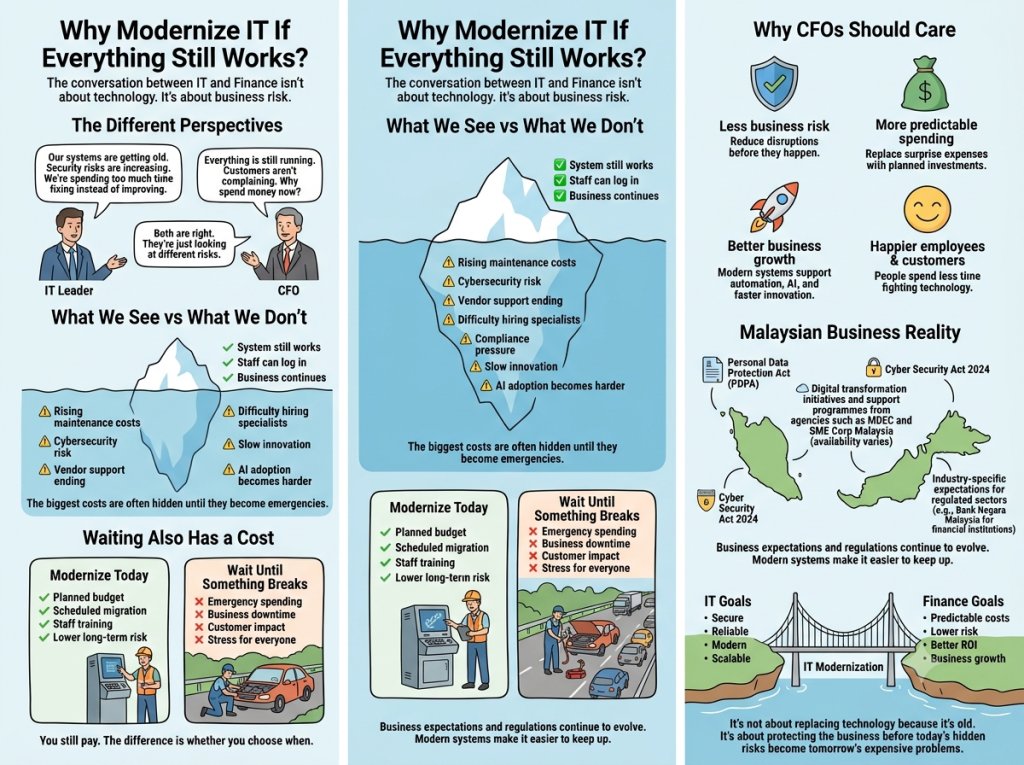
What We See vs. What We Don’t: The IT Iceberg
Picture an iceberg. Above the waterline, everything looks fine: the system works, staff can log in, business carries on as normal. That’s the part leadership sees, and it’s exactly why “keep the lights on” feels like the safe, responsible call.
Below the waterline is where the real costs tend to sit:
- Rising maintenance costs on aging infrastructure
- Growing cybersecurity risk as legacy systems age out of support
- Vendors quietly ending support for older platforms
- A shrinking pool of specialists who still know how to work on the old stack
- Compliance pressure building in the background
- Innovation slowing to a crawl
- AI adoption becoming harder every quarter it’s pushed back
None of that shows up on a report until it suddenly does — and by then, it’s rarely a good day for anyone in the room.
Waiting Isn’t Free — It’s Just a Different Bill
Here’s the point that’s easy to miss when the answer defaults to “let’s just maintain what we have”: not modernizing doesn’t mean not paying. It means paying later, usually at a worse time, on worse terms, with an audience.
Modernize on a planned schedule and the outcome looks like:
- Planned budget
- Scheduled migration
- Staff training
- Lower long-term risk
Wait until something breaks and the outcome looks like:
- Emergency spending
- Business downtime
- Customer impact
- Stress for everyone involved — including whoever signed off on “bare minimum”
Same bill either way. The only real choice is who picks the due date.
Why IT Modernization Is a CFO Conversation, Not Just an IT One
Once this gets reframed away from “IT wants a new toy” and toward business risk, the conversation tends to change:
- Less business risk — fewer disruptions before they happen
- More predictable spending — planned investment instead of surprise expenses
- Better business growth — modern systems support automation, AI, and faster innovation
- Happier employees and customers — less time spent fighting technology that should just work
That reframe is the whole game. IT modernization isn’t a technology ask. It’s a risk management conversation Finance should already care about.
The Malaysian Compliance Angle: PDPA, Cyber Security Act 2024, and Beyond
For businesses operating in Malaysia, “keep the lights on” gets harder to justify every year. Several regulatory and industry factors keep raising the bar:
- The Personal Data Protection Act (PDPA)
- The Cyber Security Act 2024
- Compliance of ISO27001, PCI-DSS
Business expectations and regulations continue to evolve. Running on modern systems makes it far easier to keep pace instead of scrambling every time the rules shift.
Two Islands, One Bridge: Aligning IT and Finance Goals
IT wants secure, reliable, modern, scalable systems. Finance wants predictable costs, lower risk, better ROI, and business growth. These often get treated as opposing goals — they’re not. They’re two ends of the same bridge, and IT modernization is what connects them.
This was never really about replacing technology because it’s old. It’s about addressing today’s hidden risks before they become tomorrow’s very expensive, very public problems — the kind that make “keep the lights on” look like the most expensive decision in hindsight.